
Hose first, then a bucket of soapy water, then a mitt, then scrub — and only at the end does it occur to them that they've been dragging whatever was on the paint across the paint.
That's the whole problem in one sentence. A dirty car isn't just dirty. It's covered in abrasives: coastal sand from a weekend on the Pacific Coast Highway, red dust from an Outback road trip, road salt from a Midwest winter, brake dust from a morning on the Autobahn. None of it is friendly to a clear coat. Press a mitt into that and you're not cleaning — you're sanding, just very slowly.
A snow foam pre-wash exists to fix the order of operations. Loosen the grit first, rinse it off, and only then touch the car.
A pressure washer removes loose dirt. It does not remove the two things that matter most: oil film and brake dust. Those act like glue. The panel looks wet, the water runs off, and the grit is still sitting there, stuck.
A car pre-wash is the chemical step that breaks that bond before you apply any mechanical force. Surfactants emulsify oils, penetrants work between the contaminant and the paint, chelants deal with the minerals in hard water, and anti-static polymers cut the electrostatic cling that keeps fine particles pinned to the surface.
Industry shorthand says a good pre-wash lifts roughly 80% of the contamination before your wash mitt ever touches the car. Treat that as a rule of thumb rather than a lab result — but the logic holds. The step you do before contact is the step that decides whether the contact does any damage.
That's also why a car pre-wash shampoo and a regular wash shampoo aren't interchangeable. One is built to be sprayed on and rinsed off without touching anything. The other assumes you'll be agitating.
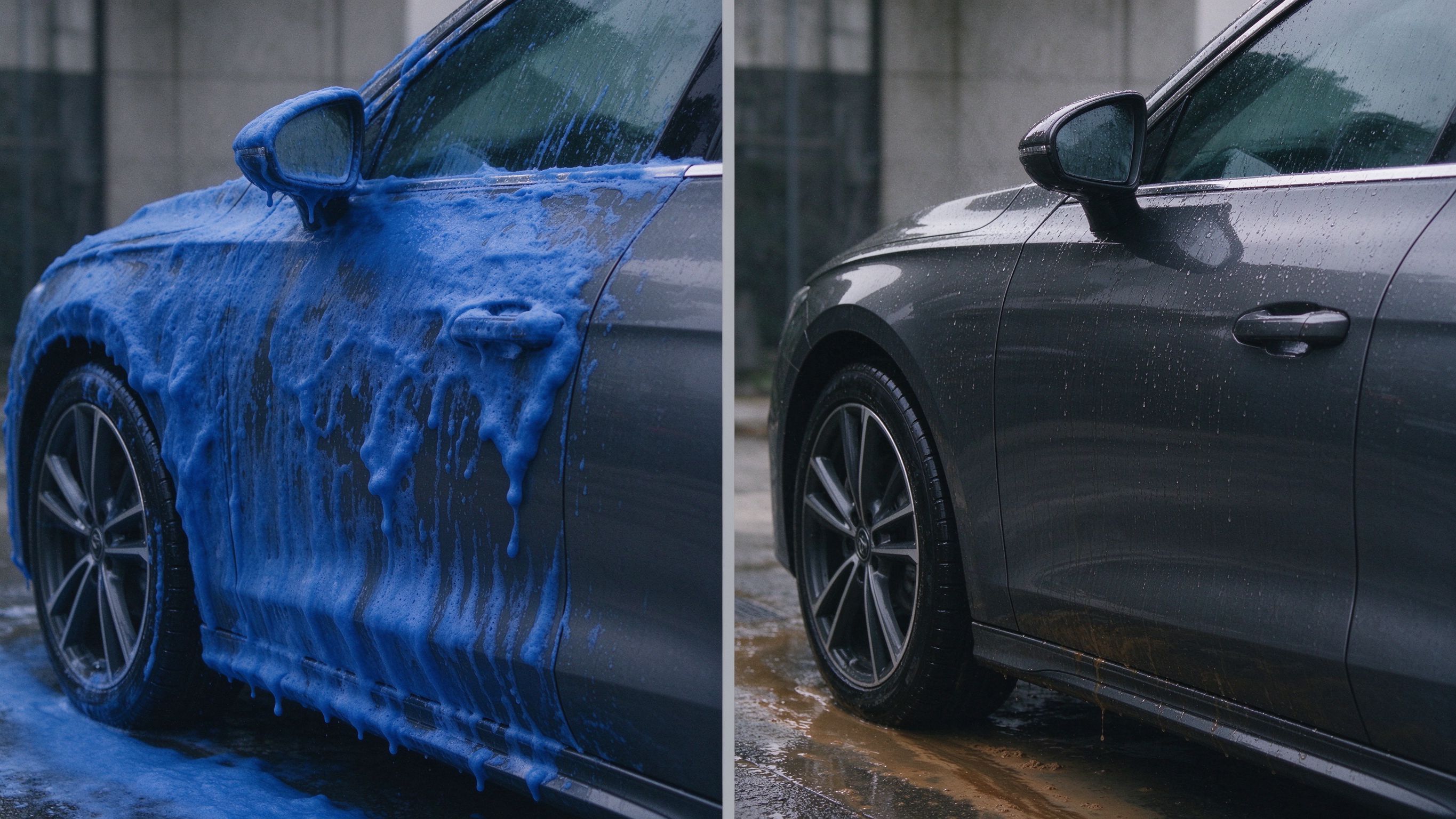
This trips people up constantly, so it's worth being precise.
High-foaming, low-contact. It's designed to cling to vertical panels, dwell, and get rinsed away. It's a soak, not a scrub.
The soapy lather you build in a bucket or a foam gun for the actual contact wash. It assumes mechanical agitation.
You can use both. In fact, on a well-maintained car you should. But a snow foam shampoo is doing a different job: it's softening the surface so that the contact wash afterward is low-risk, and on lightly soiled cars it can work as a standalone touchless rinse.
If you've been searching for a car wash foam expecting it to replace your mitt, it won't. If you've been skipping foam entirely and going straight to the mitt, that's the habit worth changing.
Because dwell time is everything, and foam is how you buy dwell time on a vertical surface.
A liquid sprayed onto a door panel runs off in seconds. Foam doesn't. A dense, active snow foam sits on the panel and keeps working — which is why the standard instruction is to spray, wait 20 to 30 seconds, and rinse. Not because the product is slow, but because the chemistry needs contact time to do anything at all.
Our formula is built around four component groups:
| Component | Job | Real-world problem it solves |
|---|---|---|
| Non-ionic surfactants | Emulsify oils and traffic film | Brake dust and exhaust film from highway driving |
| Penetrating agents | Get between the contaminant and the paint | Thin, tight grime layers from wet climates — UK, Nordic, Pacific Northwest |
| Chelating agents | Bind calcium and magnesium | Hard water in the Midwest and parts of Europe; fewer water spots |
| Anti-static polymers | Cut electrostatic cling | Ultra-fine red dust and desert sand, where particles are small and stubborn |
Nothing here strips, etches or abrades. It softens, and then water does the removal.
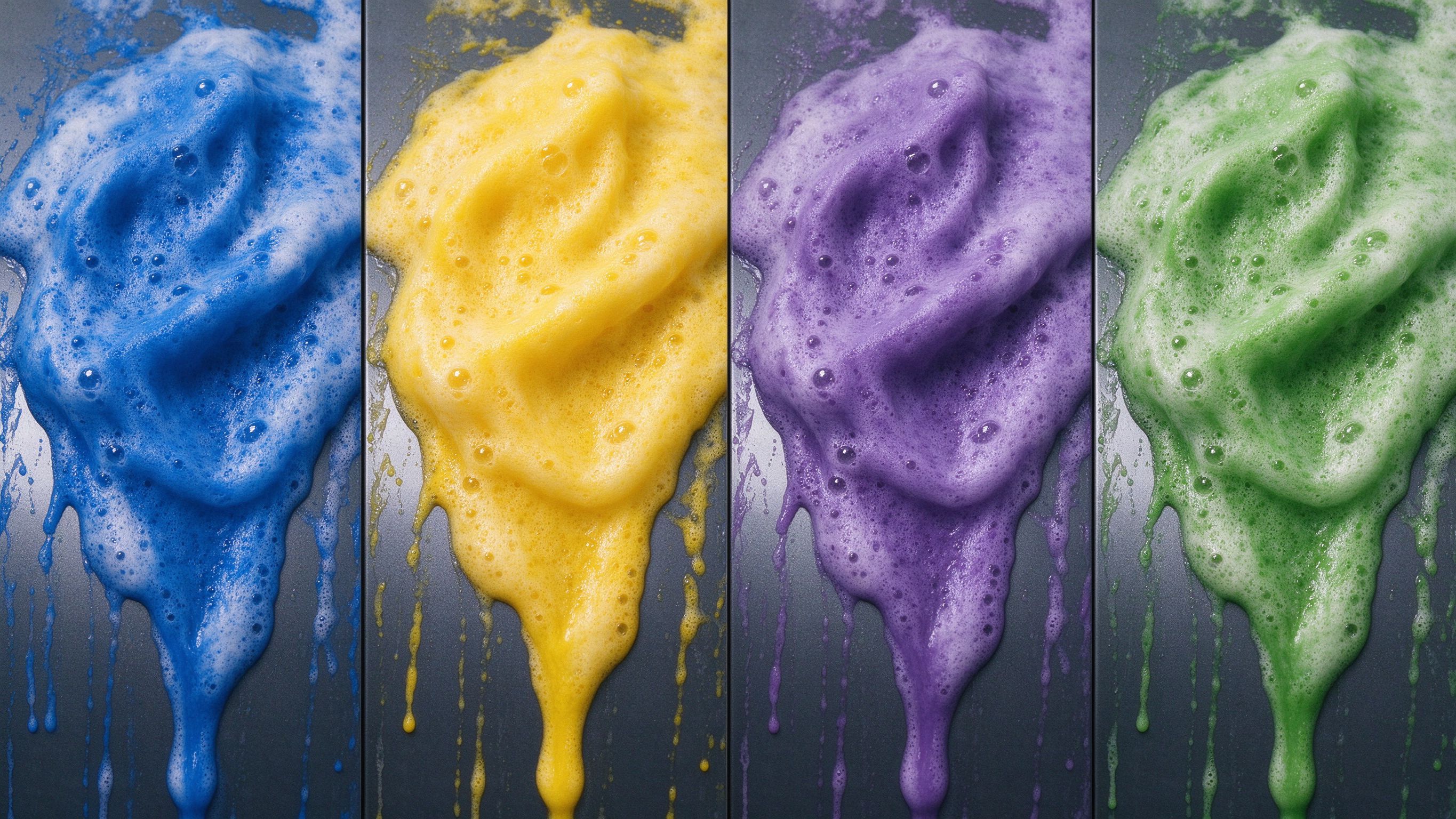
Here's the part people ask about first, so let's deal with it.
White foam is fine. White foam is also nearly invisible on a black panel, a blacked-out wheel, or anything in shadow. You think you've covered the car. You've covered half of it.
Colored foam solves a coverage problem. You can see exactly where the snow foam has landed, where the dwell is already breaking down, and which panel you missed.
So pick by contrast, or pick by mood. There is no functional argument for one over another, and anyone telling you otherwise is selling a color, not a chemical.
The color changes nothing about performance. Blue, yellow, purple and green are the same formula, the same dilution, the same cleaning ability. The pigment is water-soluble and non-permanent — it rinses away completely and doesn't stain paint, glass, wheels, trim, skin or the edges of a paint protection film.
Search interest in pH neutral snow foam is enormous, and most of it is driven by one worry: will this strip my wax or damage my coating?
Worth clearing up what "neutral" means in this category. Strictly, neutral is pH 7. Plenty of products marketed as pH neutral car shampoo, pH neutral car soap or pH neutral car wash actually sit in a slightly alkaline band. Ours runs pH 7.5–8.5 — mildly alkaline, which is the range a lot of neutral snow foam products occupy in practice, and it's what allows the formula to break down road film at all.
What matters more than the number on the label:
| ✓ | No acids. Acidic pre-washes are for mineral removal, not routine washing. |
| ✓ | No solvents. Solvents are what attack sealants and trim. |
| ✓ | No abrasives. Obvious, but still listed on some products. |
| ✓ | No phosphates. |
| ✓ | A residue that rinses clean. A pH neutral foam cleaner that leaves a film behind is worse for a coating than a slightly alkaline one that doesn't. |
That's why the practical questions are better phrased as: is it wax safe, is it coating safe, and is it ceramic safe?
Ours is formulated as a wax safe snow foam and a coating safe snow foam, and it's used as a ceramic snow foam pre-wash on coated cars — no acids, no solvents, no abrasives, no permanent dye.
On a waxed car, the thing that kills durability is repeated high-alkaline stripping, not a near-neutral pre-wash used as directed. On a coated car, the thing that kills gloss is contact marring from grit you didn't remove first.
What to avoid: the "strip wash" end of the market — high-pH, degreaser-adjacent products aimed at heavily neglected paint. Those have their place. It isn't weekly maintenance, and it isn't on top of a coating you paid for. If the goal is a gentle snow foam and a gentle car pre-wash you can run every week without thinking about your LSP, near-neutral plus no solvents is the combination to look for.
Basic rules first, because they matter more than ratios.
Cool panel, shade, no direct sun. Never on a hot surface. Above roughly 40°C / 104°F, the foam dries before it finishes working.
| Equipment | Ratio |
|---|---|
| Foam cannon (PA gun) | 1 part product : 5 parts water |
| Handheld foam sprayer | 1 part product : 150–200 parts water |
Work in shade, on a cool car.
Spray evenly over dry or slightly damp panels, bottom-up on the lower third, where the grit actually lives.
Let it dwell 20–30 seconds. Don't let it dry — drying is what leaves temporary residue.
Rinse thoroughly, top-down, with a pressure washer or hose.
Follow with your contact wash if the car needs it.
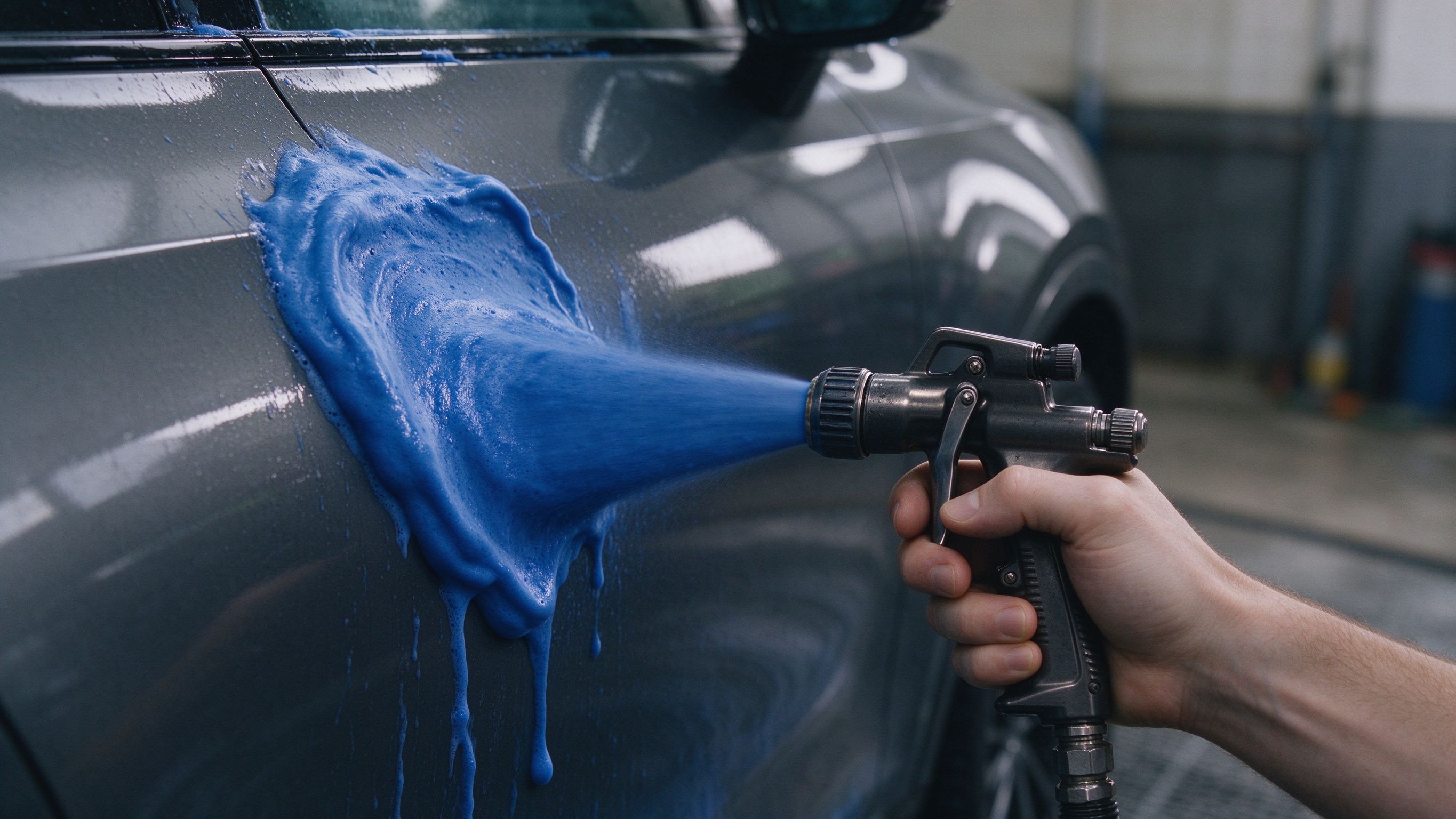
No mitt, no sponge, no brush. That's the point. For snow foam for car detailing work, this is the step that makes the rest of the wash safe — and on a maintained car with light dust, it's often enough on its own.
One note on expectations: this is a pre-wash, not a stripping treatment. It won't remove cured tar, bug residue that's been baking for a month, or water spotting that's already etched. Those need dedicated products and, sometimes, machine polishing. What it will do is take the ordinary, everyday grit off the paint without your hands being involved.
Yes, when it's near-neutral, solvent-free and rinsed properly. A ceramic snow foam step is arguably the most coating-friendly way to start a wash, because it removes grit before anything touches the surface. What coatings dislike is alkaline stripping washes and leftover residue, not pre-wash foam.
As a wax safe snow foam, yes — used as directed, at the dilution above, and rinsed. It's repeated high-alkaline washing that shortens wax life.
No. Snow foam shampoo is a pre-wash soak; car wash shampoo is for the contact wash. Same wash session, two different jobs.
You need no acids, no solvents, no abrasives, no permanent dye, and a clean rinse. A pH balanced car shampoo in the 7.5–8.5 range will usually outperform a nominally neutral one that leaves film behind. Don't shop the number alone.
Cannon if you have a pressure washer — denser foam, better cling. A handheld sprayer works fine at 1:150–200; the foam is thinner but the chemistry is identical.
Not the thickest foam. Look at dwell behavior (does it slide off in five seconds?), rinse behavior (does it come off clean without a second pass?), and what's excluded from the formula. A best snow foam claim that rests on foam volume alone is a marketing claim.
On a lightly soiled car, yes — that's the touchless use case. On anything with real contamination, treat it as step one and follow with a contact wash.
pH 7.5–8.5. Mildly alkaline, near-neutral, no acids or solvents.
| pH | ~7.5–8.5 (mildly alkaline, paint-safe) |
| Active ingredients | Non-ionic surfactants, penetrating agents, chelating agents, anti-static polymers |
| Color system | Water-soluble, non-permanent pigment; rinses completely. Blue, yellow, purple and green — identical formula |
| Base | Deionized water |
| Free of | Acids, solvents, abrasives, phosphates |
| Certifications | SGS tested, RoHS compliant, readily biodegradable, VOC compliant, meets QB/T 4525-2013 automotive pre-wash standard |
Precautions: don't apply in direct sun or on surfaces above 40°C / 104°F; don't let it dry on paint; avoid prolonged eye contact, rinse immediately if exposed; store cool, dry, away from heat and UV; keep out of reach of children.
Washing a dirty car without a pre-wash is a controlled experiment in micro-marring.
You can spend more on mitts and towels, or you can spend thirty seconds letting foam do the part that doesn't require touching anything.
The color is yours to choose. The order of operations isn't.

